Showing posts with label government. Show all posts

Thursday, October 28, 2010

Joseph Stalin

Joseph Dzhugashvili Stalin was the Russian dictator of the Soviet Union from 1929-1953. It is believed that about 20 million people died "as a direct result of his policies"1.

Stalin's childhood and early life are difficult to retell accurately. This is because Stalin went back and attempted to rewrite his own past. He was born in Georgia in 1879. It is known that his father was an abusive alcoholic. Stalin's mother had wanted him to be a priest but instead of introducing him to God, the seminary introduced him to Marxism1.*

Stalin grew to be barely five feet tall. His face was scarred (he had contracted smallpox at 7) and one of his arms was disabled to the point of preventing him from the army. Those who knew him described him as ill-mannered and rough1. Hence the change in his last name from his biological surname, Dzhugashvili, to his nickname, Stalin, which means "steel."

He joined the Russian Social Democratic Labor Party in 1901, where he used robbery and counterfeiting to gain revenue. Only 2 years later, he was caught and sent to Siberia, but he escaped. He went on to be arrested 5 more times.

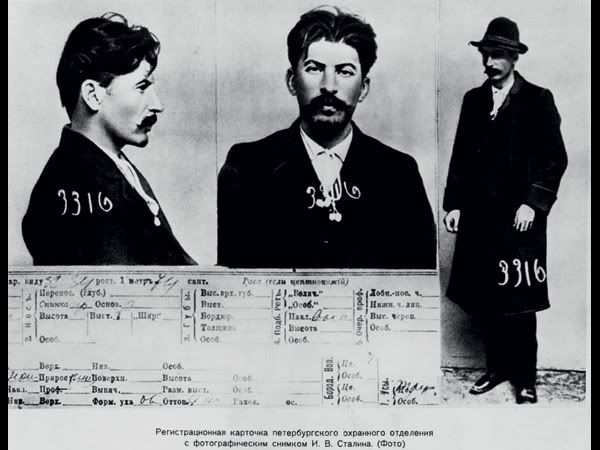
Stalin's registration card with the St. Petersburg Police Department2
Stalin was freed from his last conviction during the 1917 Bolshevik Revolution. He became editor of Pravda ("Truth"), the Labor Party's newspaper. This was his first position of true power. In 1923, he became secretary general of the Communist Party1. He devoted his life to his occupation and increasing his ranks and he fought ruthlessly against opponents.

Using Lenin's work as "rough draft," Stalin refined his bureaucratic system, secret police, and slave labor camps. However, unlike his predecessor, he had capitalism completely banned. He demanded complete focus on industry as well as "collectivization of agriculture," the latter of which would kill roughly 15 million people1. (For more on how Stalin starved the very people making the Soviet Union's food supply, stay tuned for the article on the Holodomor.)

Stalin also initiated his infamous Great Purges, in which he removed all potential threats by sentencing them to public "show trials" and then condemning them to execution or lengthy sentences in harsh labor camps (gulags). Disturbingly suspicious of Western influence, nearly anyone who had been to the West - voluntarily or otherwise - was looked upon as an enemy.1 In a later event known as the Great Comb-Out, 8 million people "simply disappeared" without any sort of a trial. 7 million were sentenced to gulag camps. The other 1 million were killed.3

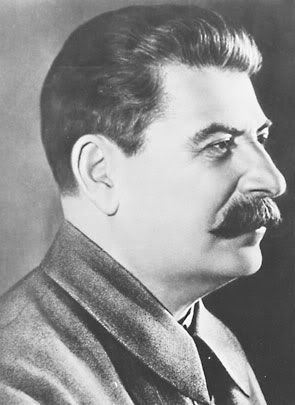
Joseph Stalin, 1942.


Stalin used heavy propaganda to promote strong nationalism and in hopes of getting the public to hold his same anti-Western ideology. He was also responsible for the launching of the Cold War, and he tried to develop an atomic bomb. He agreed with North Korea's invasion of South Korea, hoping the peninsula would fall completely to communist control. He also attempted to have 9 doctors convicted of assassinations. 6 of them were Jewish, and this was partially an act of anti-Semitism.1

However, these allegations, that became known as "The Doctor's Plot," were never carried out, as Stalin died on 5 March 1953.

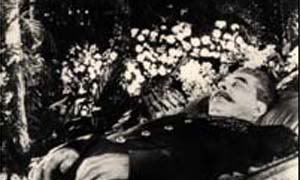
Stalin died in 1953 after a paralytic stroke.
Works Cited and Recommended Further Information
  • 1 Tucker, Spencer C. "Joseph Stalin." World at War: Understanding Conflict and Society. ABC-CLIO, 2010. Web. 22 Oct. 2010.  
  • 2 "A short history of mugshots." Slate. 21 Oct. 2010. Web. 22 Oct. 2010. <http://www.slate.com/id/2270770/> 
  • 3 Frame, Arthur T. "Soviet Great Purges: World War II." World at War: Understanding Conflict and Society. ABC-CLIO, 2010. Web. 22 Oct. 2010.
  • 4 "Joseph Stalin." Image. Library of Congress. World at War: Understanding Conflict and Society. ABC-CLIO, 2010. Web. 22 Oct. 2010. 
  • "Revelations from the Russian Archives." Library of Congress, 1992. Web. 22 Oct. 2010.
  • Simkin, John. "Joseph Stalin: Biography." Spartacus Educational. Web. 22 Oct. 2010. <http://www.spartacus.schoolnet.co.uk/RUSstalin.htm>
  • Service, Robert. Stalin: A Biography. Pan, 2010. Print.
  • Shalamov, Varlam, and John Glad. Kolyma Tales. Penguin, 1994. Print.

* - I feel it necessary to mention that true Marxism does not equate to the communism Stalin imposed on Russia or many modern ideas of what communism is today. To fully understand what Marx really argued, read his Communist Manifesto.

Friday, October 22, 2010

The Salem Witch Trials

   The Salem witchcraft trials can all be traced back to two young girls, the daughter and niece of Reverend Samuel Parris. The girls went to a slave woman named Tituba and asked to have their fortunes read. Later, the girls began to exhibit strange behaviour, such as temporary blindness or deafness or periods of uncontrollable screaming.3 The Puritan town of Salem in which the girls lived decided this was the work of Satan. The girls pointed the blame at Tituba, as well as two other women, Sarah Osborne and Sarah Good. Despite Good's insistence that she "was falsely accused," all three were imprisoned.4 The two young girls began to blame more and more people as their odd symptoms continued.

   "Twenty-seven individuals were tried for witchcraft between June 2 and September 17, 1692; the 19 who refused to confess were executed."1 By the end of the hysteria, almost 150 people had been jailed and accused of witchcraft. To be found innocent was nearly impossible. In fact, at one trial in which the jury came back with an innocent verdict, the judge demanded they "deliberate further." They came back quickly with a guilty verdict, and the woman accused, Rebecca Nurse, was executed.3

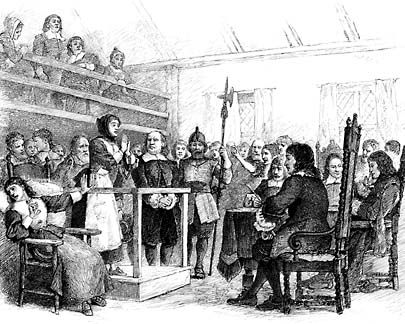
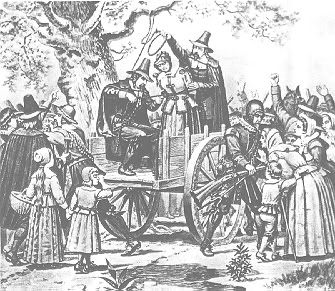
A woman is accused of witchcraft in 1692.2
   Punishments were severe, despite the fact that many of the convicted were actually devoutly religious people. One man was pressed to death. Another recited the Lord's Prayer while being executed, which was thought impossible under Satanic possession.1 Some of the victims were burned. However, most of those killed were women, and most of them were hanged.

A woman found guilty of witchcraft is publicly hanged.


   By 1710, most of the names of witch trial victims had been cleared and their families compensated. No one is really sure what caused the bout of hysteria in the Salem area of Massachusetts. Some attribute it to the misogynistic attitudes of Puritanism. About 85% of the accused were women, most of whom did not fit the traditional roles of the society.3 Others attribute it to PTSD due to recent wars or even simple human emotions such as jealousy. But no theory is definite, and it will most likely remain a mystery as to how an entire region went into such panic, costing 20 people their lives.

   Disturbingly, witchhunts are not a thing of the past. In northern Ghana in and around 2005, local women were blamed for many of life's day to day problems, accused of being witches, and killed. You can read more about the issue in Ghana here.


Works Cited
  • 1 "Salem witchcraft trials." American History. ABC-CLIO, 2010. Web. 18 Oct. 2010.
  • 2 "Salem witchcraft trials." Image. North Wind Picture Archives. American History. ABC-CLIO, 2010. Web. 18 Oct. 2010.
  • 3 Loiselle, Brett. "Salem Witch Trials." EBSCOhost. Web. 18 Oct. 2010.
  • 4 "Salem Witch Trials." The Religion Book: Places, Prophets, Saints, and Seers. p.415-418. ESBCOhost. Web. 18 Oct. 2010.